













Douglas Duncan, CIO, Columbia Insurance Group
CIOs are all faced with challenges in building the best possible team to get the job done. You might be new in your role, or well-seasoned, but the question is the same – how do you make the best out of your imperfect situation?
Very few of us are successful because we individually can do everything. We all rely on our teams. We all want our teams to be the best they can be. And we all know our teams can be better than they are.
There are many ways to make our teams better. Hire new talent. Bring in expert consulting. Steal that genius from the other department. Send your people to training. Get rid of the dead weight. Start an employee engagement program. Increase pay or bonuses. However, these approaches are all tactical and often not successful. The problem is not the tactic, but the strategic context within which it is executed.
Strategy is in understanding the nature of the work environment
A strategic way to make your team better is to understand the nature of your work environment and create the right conditions for improvement. Plan your actions in the light of how your organization operates and what is considered important. Be realistic about the shortcomings as well as the strengths. Create a framework to organize your thoughts and how to assess your particular situation.
First, think about the key elements are that will impact your team-building exercise. What makes your situation unique? Is the urgency for change high or low? Are the resources limited or plentiful? Is the organization supportive of your leadership or resistive?
Second, realize you can only control the framework you use. The actual facts on the ground are what they are; you simply need to make a bad situation better or a good situation great!
Your unique challenges and interactions will inform your optimal approach
When I started my current role last year I was the “new kid”. I knew this would play into how my ideas were viewed and how my team would function. There is high interaction between the newness of the leader and the culture of the organization. I created a 4-block view comparing these two factors to help me think through the optimal strategy.
The vertical axis is “New Kid” versus “Old Salt”. The horizontal axis is organizational resistance to change, as in a “’No’ culture” versus a “’Go’ Culture”.
The quadrants show the four key interactions and point to the best strategy given the environment.
A strategic way to make your team better is to understand the nature of your work environment and create the right conditions for improvement
Unleash. The intersection of new kid and a “no” culture suggests an approach to unleash the talent within the existing team that was previously held back. They have been waiting for the opportunity, the permission to make a change. Be a role model and demonstrate through your actions and ideas a way forward, and empower your team to take the lead.
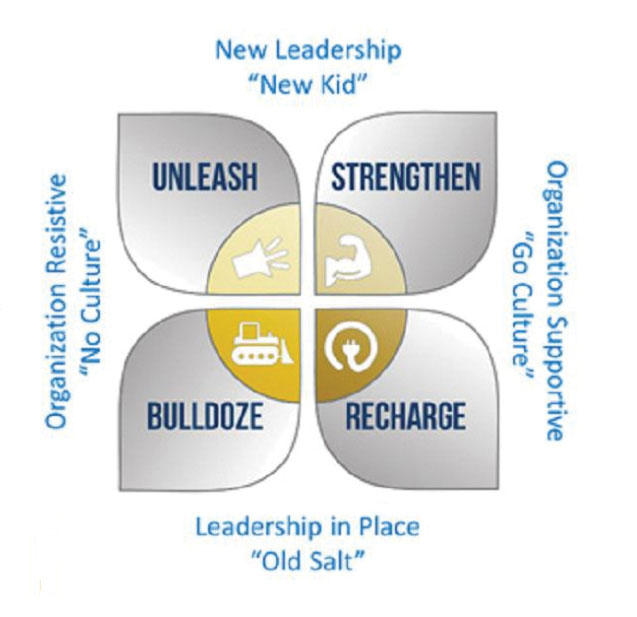
Strengthen. Where a new kid meets a “go” culture, you should build upon the good and set high expectations. You have a very supportive organization behind you, and you do not have to recreate the wheel. You should use your newness to the team as a joining of two goods to make a great.
Recharge. If you are in a “go” culture and are not new to the team, but feel the need to kick things into gear, then you should create new team or project structures and opportunities. This should focus on correcting current team shortcomings, but more importantly can get people charged up about the change. The team will understand that while many of the faces are the same, it is a new day and exciting things are happening.
Bulldoze. Where old leadership intersects a “no” culture, you face a lot of challenges. Fear not, even without an organizational appetite for change, you can still get things started by knocking down the old structures and relationships. It is a drastic and risky, but this unfortunate scenario calls for a bit of constructive destruction in order to rebuild.
Last year I started in the Unleash quadrant and am happily moving into the strengthen space. My team has run with their empowerment and is meeting higher and higher expectations. I was fortunate that the organization was ready to think differently about change and have begun to embrace it as they see the opportunities it can bring.
You can customize the framework to your specific needs
I have developed many additional frameworks using this approach, including pressure to change versus appetite to change, level of resources versus urgency of problem, and span of control versus staffing structure. You can do the same by thinking about the options you have as the intersection of two organizational factors that highly interact. You will be surprised at how clear the options become when put within the proper framework.
Check This Out: Top Leadership Development Training/Coaching Companies in UK
