

A featured contribution from Leadership Perspectives: a curated forum reserved for leaders nominated by our subscribers and vetted by the Construction Tech Review Advisory Board.

SWIFT APAC
Strengthening Endpoint Security

Saqib Sheikh
According to the Financial Stability Board, 72 percent of jurisdictions have recognized the threat and released plans to issue new regulations on cybersecurity for the financial sector. The Committee on Payments and Market Infrastructures too has issued a discussion note on reducing risk of wholesale payments fraud related to end endpoint security, proposing a strategy to identify and understand the range of threats, establish security requirements, promote adherence and information sharing, provide tools, speed response times, and to learn from past incidents.
In response to the cyber-threat facing the banking community, SWIFT established the Customer Security Programme (CSP) in 2016. This strategic programme is designed to raise awareness of cyber risks and empower our customers in their response.
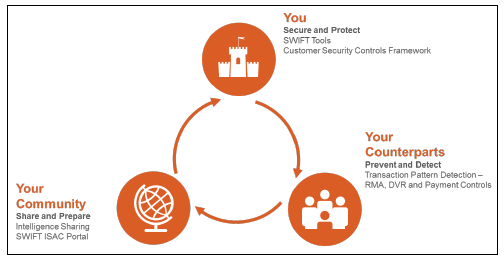
The programme comprises of three pillars:
• Secure and protect – a set of tools and security framework to protect your operating environment
• Prevent and detect – services to secure relationships and transactions with your counterparties
• Share and prepare – timely and actionable cyber intelligence shared with the community of SWIFT users
Cyberattacks Are Inevitable, and Cybersecurity Should Be Assumed as Part of the Cost of Doing Business in a Digital Economy
Within the programme, the Customer Security Control Framework (CSCF) establishes a new minimum security baseline. The baseline goes beyond SWIFT software and technology, defining control objectives and risk drivers across people, process and physical controls. Compliance to this baseline is determined through self-assessment by SWIFT users or by independent assessors. Published and consumable by regulators and counterparties in an online KYC Security Attestation (KYC-SA) application, this data has become valuable input in determining counterparty risk.
A new Payments Control Service (PCS) was launched in 2018, enabling real-time screening of anomalous transactions. This cloud-based, zero-footprint solution allows customers to define their own rule sets and screen for transaction values and volumes, business hours, suspicious accounts, currencies, countries, and other uncharacteristic behaviors.
 The SWIFT global payments initiative (GPI) is transforming correspondent banking. By establishing a unique transaction reference number across the chain of counterparty banks, it enables faster,efficient payments combined with transparency of transactions and fees across the payments chain. The GPI Stop & Recall service is a powerful automated tool in stopping fraudulent transactions before they reach mule accounts.
Cyberattacks are inevitable, and cybersecurity should be assumed as part of the cost of doing business in a digital economy. While SWIFT continues to do its part and invests heavily in raising awareness, providing new tools and intelligence, to effectively responding to these threats requires collaboration between all stakeholders. Financial institutions, their vendors, regulators, and government agencies must co-create new tools, establish market practices for information sharing and practice incident responses together.
To conclude, cybersecurity is the responsibility of the entire institution and should be a recurring Ex-ecutive and Board agenda item. Such a detailed review will strengthen operations capability, enabling effective fraud detection, response and recovery.
Check out: Top Endpoint Security Technology Companies
